This is a translation of the fourth chapter of Jeyamohan’s அருகர்களின் பாதை.
I woke up this morning in Varanga. I cannot say the same for everyone else; many hadn’t slept at all. The marriage hall we stayed in was as open as the outdoors, with many open windows. Consequently, the cold was severe. I had predicted earlier in the night that it would get cold, but everyone dismissed it, claiming, “We don’t feel cold at all,” and went to sleep. I, however, wore the sweater Muthukrishnan had bought for me and managed to get some sleep. In the middle of the night Rajamanickam’s cellphone started ringing accidentally, waking everyone up and ensuring they stayed awake. When I finally awoke, everyone looked around with bleary eyes.
We walked through the chill to the Varanga lake temple. A layer of mist rose from the lake like steam from a hot cup of coffee. Inside the water, thousands of fish throbbed and blinked like eyes. The priest was waiting for us; he took us to the other bank by boat. In our village, we call the light just before sunrise manivelicham (light from a gemstone). At that hour, all colors appear with distinct clarity. We stood there listening to the cooing of pigeons. I looked with affection at Rajamanickam, who had suggested the previous day that we could simply sleep in the open air. How wonderfully clear-headed human beings think they are!
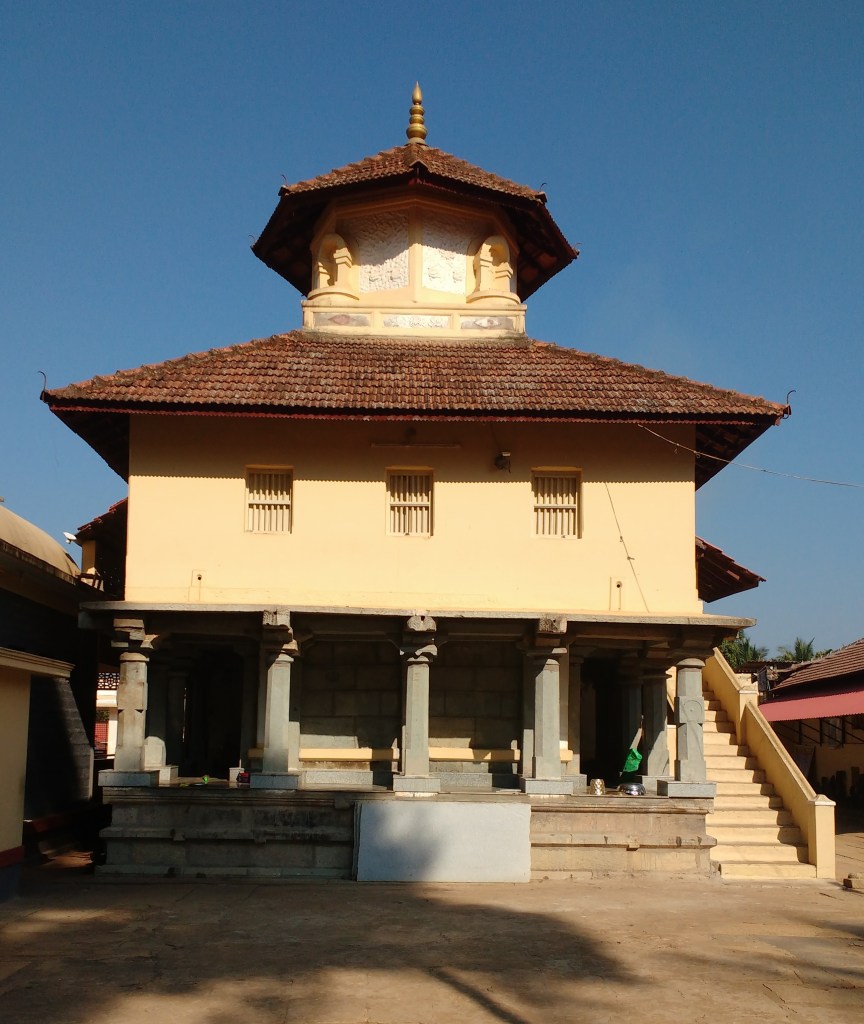
The Neminatha Basadi in Varanga is almost as large as the one in Karkala. Its grandeur is not immediately apparent from the outside. Built in the Canara style, it features heavy pillars supporting a sloped roof of stone slabs. We entered and circled the silent temple. It remained closed, feeling as though it existed at a depth centuries away, unknown to us.
The priest, a 60 year old man, was staying in the adjacent house. He came and opened the temple to perform the aarthi. The morning hour at Varanga felt like it was unfolding in some distant past. “It feels like being inside a work of fiction,” Seenu remarked.
After breakfast, we set out with the plan to go straight to Kundadri. We drove to Agumbe and asked for directions from there. Kundadri is a small hill, yet it sits at a high elevation. The car can go all the way to the top, followed by a short flight of steps to the summit of the Basadi built in the 10th century. It has since been renovated. There are two deep, sunken water tanks teeming with shoals of fish. Looking down from the hilltop at the immense greenery spread out below is an experience that expands the mind.
From the distance, we heard faint human voices. I had never thought the human voice could carry such a mixture of yearning and softness. It appeared that the surrounding forests and the villages deep within them remained unwarmed by the heat of motorized modernity.
We left Kundadri for Humbaj. Although the afternoon sun began to climb, the wind remained cool. The road was flanked by forest on both sides, with dense clusters of trees and a river occasionally showing its head. We reached the Humbaj monastery at 1:00 PM.
This town is also known as Humcha or Hamsavathi. It is a small village in the Shimoga district, famous for the temple of Padmavati Yakshi, the guardian deity of the 23rd Tirthankara, Parshvanatha. The temple has been renovated and looks brand new.
The Humbaj Mutt is located here. It belongs to the Mesha Pasha Gacha Bhattaraka tradition. The Bhattaraka system is a lineage of Jain temple trustees or pontiffs. They wear saffron robes and manage Jain temples. They are ascetics, but they’re not fully renounced monks.
The pontifical seat at Humcha is said to have been established around the 8th century, possibly by Jinadatta Raya, the founder of the Santar dynasty. Records in Banavasi show that in 1048 AD, the Mahamandaleshwara Chandraraya made endowments to this monastery.
The most extensive Bhattaraka lineage in Jainism is the Mulasangha Nandisangha Balakaragana Saraswati Gacha tradition, abbreviated as MNBS. Its seats are found in various towns like Surat, Idar, Ajmer, Jaipur, Chittoor, Nagoor, Gwalior, and Chanderi. Many Bhattarakas of this lineage have been great scholars and sages.
Humbaj is the center of the MNBS tradition. The current head is Bhattaraka Devendra Keerthi. He is the only remaining Bhattaraka of this lineage; the other seats have perished. At the mutt’s entrance, we met a group of strictly traditional Tamil Jains from a village near Villupuram. They said they were building a Jain temple for Parshvanatha in their town at a cost of one crore rupees and had come to seek the Guru’s blessings.
We went to the mutt’s dining hall for lunch. It was the first proper meal we had eaten since our arrival – hot rice, sambar, buttermilk, and a side of chickpea curry. The moong dal payasam was exceptionally tasty; we asked for a second serving.
We then met the Bhattaraka. He was a young man, likely under forty, and we were told he had only recently assumed the position. He blessed our journey and suggested we visit the marble Parshvanatha statue on the nearby hill and the five-storied Basadi.
The marble Parshvanatha statue on the hill was installed twenty years ago. After being abandoned for some time, it is now being repaired. It is an average statue, about twenty feet high. However, the Panchamukha (five-faced) Basadi nearby, which is under the control of the archaeological department, was the most magnificent thing we saw on this trip. The sculptures were marvelous. Since we had to enter the sanctum to see them, we had an elevated sense of awe and rapture.
Outside, a statue of Jwalamalini Yakshi had been left simply sitting there, yet it was complete. It was a great work of art, holding endless intricacies in every inch. We spent nearly half an hour looking at that single statue. She wore a large floral crown in the Halebidu style, along with garments and a waistband hung with bells. The jewelry was carved into the black stone with a precision that rivaled goldsmithing.
To the side of the complex stood a small Parshvanatha temple built by the Kadamba kings in the 5th century. The Panchamukha Basadi itself was built in the 12th century, with various structures added in later periods. We went into each sanctum to view the colossal Tirthankaras seated inside. Viewed in the darkness by the light of a mobile phone, they looked as if they were rising out of a dream.
I stood close to Parshvanatha, who sat untouched by the temptations of the surrounding deities – the Manovikaris (embodiments of desire) described in Jain iconography. He stood as a symbol of the heights a human can reach, the ideal form of the concept of ‘man.’ His body possessed the perfect Samudrika features; there was completeness in every aspect. Yes, Tirthankara worship is essentially man worshipping the humanity residing within himself.
Our friend and reader, Ravi, came looking for us in his car from nearby Shimoga. He brought fruits and woolen blankets for each of us, mentioning that he had read our post about the cold the previous day.
Our destination was Mulgund, near Gadag, at a distance of 220 kilometers. We decided to cover as much of it as possible. The road was good, flanked by forests. At one point, a dhole (wild dog) even darted across the road. As evening began to fade, we arrived at the banks of the massive Linganamakki reservoir. It was vast, comparable to the Veeranam lake, with water stretching for kilometers.
We stepped out onto the banks and watched the sun extinguish itself behind the low hills across the expansive water. Today’s sunset, today’s flood of crimson light, today’s completeness.
We traveled through the dust again into the night, reaching a small town called Ranebennur at eight o’clock. We booked a single room for everyone in a small lodge. One of us had to sleep on the floor. We suspected it would be cold.
“Of all the days so far, today offered the peak artistic experience, Sir,” said Krishnan. It is his custom to declare every evening, for one reason or another, that that specific day was the greatest.
 Transverse