This is a translation of the second chapter of Jeyamohan’s அருகர்களின் பாதை.
We woke up in the early hours of the 15th. Having written my travel notes and posted them online the previous night, I had only gone to bed at eleven. Krishnan came and woke me up at four in the morning. It was the severe, piercing cold typical of the Deccan Plateau. To make matters worse, there was no water. My friends went to a tap in the front yard. When I followed, I saw the watchman approaching. I told him there was no water; he went to the tap, opened the faucet and after verifying he then went to switch on the motor to fill the water tank. It was only then that I realized something – I had spoken to him in Hindi!
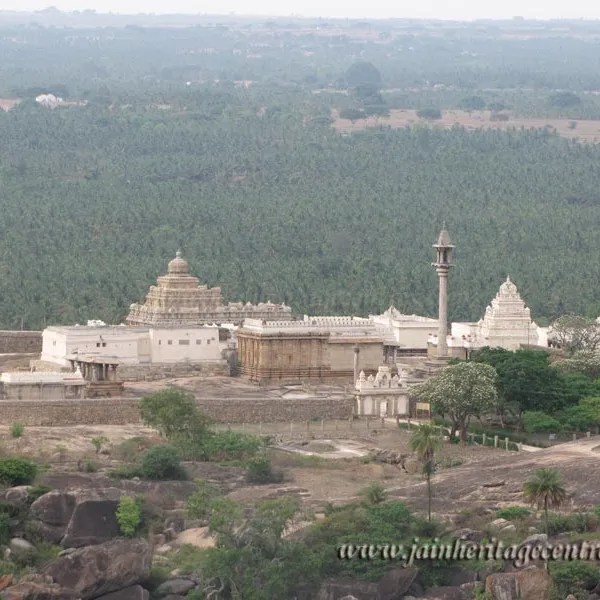
Bathing in cold water in such chilly weather requires a specific talent: the ability to suspend thought for a split second. The brain only registers that we have bathed after the act is done. Since the body returns to room temperature after the bath, we even feel a little warm. By the time we changed and left, it was five o’clock. We walked through the darkness and climbed Chandragiri. It is not as tall as Vindhyagiri, but it is also a monolithic rock hill. We ascended via ancient steps carved directly into the rock. None of the temples on Vindhyagiri were open at that hour, so we stood atop the rock on the hill’s summit to watch the sunrise.
A rule I always follow during my travels is never to miss either the sunrise or the sunset. My experience is that one must be out in the town at these times to truly feel its beauty and understand its life. In holy cities and ancient towns, viewing the vast landscapes at dawn and dusk embeds them deeply in our inner selves.
The sunrise today was magnificent. We were surrounded by a vast expanse of land, where silence seemed to have ripened into a golden harvest waiting to be reaped. We were at a height where the earth shrank into a landscape painting. The lakes looked like embedded mirrors, the streams like slithering glass snakes, and the tar roads like braided black hair. Groves of trees appeared like patches of velvet moss floating motionless on a film of water.
The sun was tucked inside, like a golden child curled up asleep under a blanket, though his light was already upon the sky and earth. The clouds were glowing. As the light turned redder, the curtains parted, the gates opened, and a golden colossus rose in the East. As the light spread, hundreds of small flycatchers flew across the sky as if fanned out, diving into invisible whirlpools and rising again in jubilation. The light hit the steam rising from the ground below, turning it into golden clouds that drifted upward. As the sun spread over the earth, everything gleamed distinctively before fading and dissolving into the yellow light. Silence has a way of aggrandizing every sound, both inside and out.
There are numerous Jain temples all over Chandragiri. This site has existed since the 3rd century B.C. It is said that Chandragupta Maurya, the founder of the Magadha Empire, embraced Jainism under his Guru Bhadrabahu, became an ascetic, came to this hill, and performed Sallekhana (fasting to death) here. This event is described in several Jain texts. Jain tradition holds that sixteen dreams seen by Chandragupta Maurya led him to this decision. This event is carved in stone on the window of the Parsvanatha temple here.
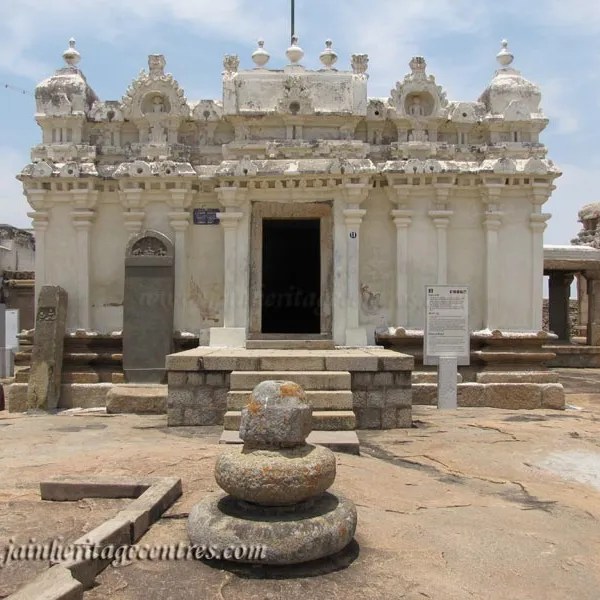
We spent the entire morning walking and looking at the temples on Chandragiri. Standing before the sanctum where the magnificent Parsvanatha stands gleaming in black, the mind momentarily lost its sense of place and existence. These are beautiful small temples, featuring cylindrical pillars and square Mukhamandapas. Most of the main deities are carved from black marble. There is a rare beauty in blackness; it reminds one of depth. The black Tirthankara statues all looked like forest springs that had absorbed everything into themselves, lying still without a ripple. They created an illusion that they would be cold to the touch, and a fear that if one slipped, one would fall into a bottomless, freezing depth, eventually shrinking into an atom under the pressure of that silence.
Then there were the nude statues. These are statues that make one feel that nakedness is the natural state, filling the heart with a deep shame for one’s clothes. There are many temples dedicated to Parsvanatha, Adinatha, Shantinatha, Vardhamana, and Chandraprabhanatha. Here, there were also temples with large sanctums for Tirthankaras like Manjunatha and Mallinatha. Kushmandini Devi (she who holds a flower) was often seated at the entrances, flower in hand; in some temples, it was Padmavati Yakshi (she with lotus eyes), her eyes set in silver.
When we came down, a small dispute ensued. Because we were late coming down the previous day, the place where we had left our footwear had been locked. When we asked for our sandals in the morning, an old man made a big fuss. Finally, he demanded a bribe of one hundred rupees. We paid the money and retrieved our sandals. I insisted we should complain. Krishnan felt we shouldn’t spoil our mood. My stance, however, was that such behavior should not be ignored, because these people operate on the boldness that not even one in a hundred will complain. Characters like this can make an entire trip unhappy for many. So, we went to the office and reported it. The official there, Mukund, was shocked and saddened. He apologized, saying, “Sir, this would never happen in a Jain place.” He immediately returned the money and ensured we filed a written complaint against that individual.
We bought some books there and left. This was the first long drive of the trip, approximately 200 km. We crossed the Western Ghats. Dense forest lined both sides, and at one point, we saw a blue river named Gundya. We got down and bathed in the river. It was cold, clean water. It was one of those rare, wonderful baths; Arangasamy said it reminded him of bathing in the Ganga. We ate tamarind rice right there.
We reached Dharmasthala at four in the evening. I have visited Dharmasthala many times. First in 1984 during my days working in Kasaragod, and most recently with Vasanthakumar, Yuvan Chandrasekar, and Shanmugam. Dharmasthala has now become a major pilgrimage site in the South. In those days, it was a very quiet hill retreat. Suddenly, Ayyappa devotees started showing up. Now, it is full of crowds, noise, and bustle. Dharmasthala has accommodation for up to a thousand people, but we were told all rooms were occupied. It seemed unlikely we would get the free food either. So, we decided to visit only Ratnagiri, the Jain center there, and turn back.
The Manjunatha Swamy temple in Dharmasthala is built in the Kerala architectural style, with a tapering, tiled circular roof. We did not go there; had we gone, we would have had to stand in line for the rest of the day. In reality, this site is an ancient Jain center. True to its name, it is a house of charity and food. They say its antiquity dates back to before the B.C. era. A thousand years ago, this town was known as Kuduma or Mallarmadi (reminding me of Kudumiyanmalai). The nearby town is Belthangady, meaning ‘White Market’. That market was a key trading post. This was the opening of the Jain trade route from the North into the Chera country.
Over time, the place fell into ruin. Around the 12th century, a Jain monk came looking for Birmanna Pergade, the local ruler governing nearby Belthangady, and told him about this place. Following the monk’s instruction to foster charity here, Birmanna Pergade and his wife Ammu Ballathi re-established the Annadana (food charity). Their family home is known as Nelliyaadi Beedu, and they are the trustees of this town. Veerendra Hegde is the current trustee.
Even during Pergade’s time, several local deities were installed here. Pergade established and worshiped deities like Kalarahu, Kalarkayi, Kumaraswamy, and Kanyakumari. Later, when he invited Brahmins for pooja, they requested a Shiva Linga be established. It is said that the local guardian deity, Annappa, brought the Linga from nearby Kadri and gave it to the trustee Hegde.
In the 16th century, Vadiraja Swami, the pontiff of Udupi, came here at the invitation of the trustee Devaraja Hegde and consecrated that Linga as a temple. That is the Manjunatha Swamy temple. To this day, it remains a place of free food charity. Up to five thousand people eat here daily.
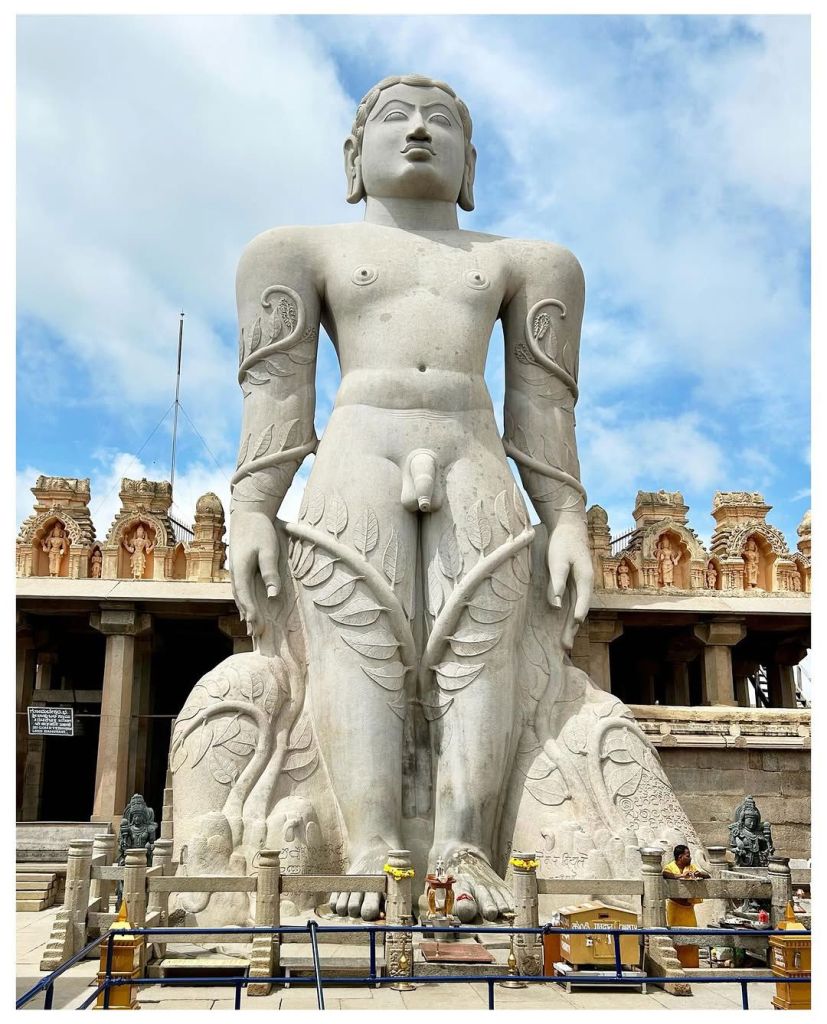
On Ratnagiri, stands the statue of Gomateshwara. This is the third tallest Gomateshwara statue in Karnataka, one meter shorter than the one at Shravanabelagola. This massive statue was planned in 1966, completed in 1976, and brought here and installed in 1982. Veerendra Hegde took the initiative to install it. The statue stood towering and majestic. Standing before it, I thought once again of the magnificence of renunciation rising high above all possessions.
We decided to go to Moodbidri and stay there. Red dust flew on the road we traveled. With the evening sun burning like a fire ember on the red dust, we arrived in Moodbidri around seven o’clock. We found a place to stay in the Dharmasala there. The Jain temples all close their doors at six o’clock, so we would have to see the temples tomorrow.
 Transverse