This is a translation of the first chapter of Jeyamohan’s அருகர்களின் பாதை.
I arrived in Erode around midnight on the 12th. Krishnan had come to the railway station to receive me. From there, we went straight to Vijayaraghavan’s house, where Prakash Sankaran had already arrived. He is a native of Chozhavandan, currently doing research in biology in the Czech Republic, and is also one of my readers. Many of his letters have been published on my site. With his tuft of hair (kudumi), he looked distinctive. We spent most of the night talking, and it was quite late by the time I finally managed to sleep.
When I woke up in the morning, I had to write an essay in Malayalam about the Kamba Ramayanam. Atroor Ravivarma is bringing out a book translating selected poems from the Kamba Ramayanam, and this essay was meant to serve as its preface. He had been asking for it for a long time, and I had completely forgotten. He called and said he needed the essay immediately. I felt it had to be written before the journey. I set an alarm on my mobile for 6:00 AM, woke up, and started writing. Perhaps it was that mindset, but I was able to write right away. I wrote sixteen pages rapidly. The structure and language of the essay turned out perfectly. I made arrangements to send it to Atroor.
The entire day was spent chatting with friends, who kept dropping by. Since Vijayaraghavan’s house was empty, it was convenient for conversation. Damodhar Chandru from Erode came to invite us to his son’s wedding. We told him we would be in Rajasthan at that time. My mind was full of thoughts about the journey. We kept talking through the day. Cuddalore Seenu arrived in the afternoon. In the evening, K.P. Vinoth and Muthukrishnan arrived. Muthukrishnan works in the computer field in Germany. It was late by the time we went to sleep that night as well.
We woke up at 4:00 AM. Arangasamy had started from Coimbatore in his car at 2:30 AM and was on his way. His mother-in-law had made and sent pongal and murukku. A reader friend from Tiruppur, Chandrakumar, had also packed enough food to last for three days. He had even bought and sent the necessary clothes for everyone. After loading everything, Arangasamy arrived at 4:30 AM. We set off exactly at 5:00 AM as planned, traveling in an Innova with a total of seven people: Arangasamy, myself, Krishnan, Seenu, Muthukrishnan, Rajamanickam, and Vinoth. The driver was a young man.
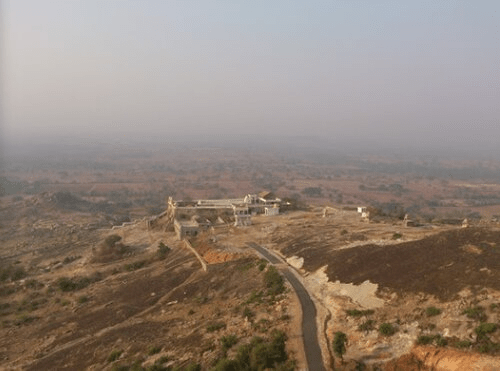
We drove through the early morning chill, talking as we went. As dawn began to break, we reached Sathyamangalam. We entered the Karnataka border, watching the yellow light spread. Our first destination was Kanakagiri. This small hill is located in a hamlet called Malaiyur near Chamarajanagar. Kanakagiri holds an important place in Karnataka’s history and is one of the most ancient Jain sites in the state. Situated on the route where Jain trade paths leading to Tamil Nadu converge toward the Sathyamangalam mountain gap, this place must once have been a major religious center. The ancient Jain historian Nagoboma Shaila has mentioned this site, and there are references to Kanakagiri in several ancient Jain texts.
It does not appear that anyone has examined this town in connection with Tamil history. In particular, there is a theory that this was the route taken by the Kalabhras to enter Tamil Nadu. The golden age of Kanakagiri was from the 2nd century AD to the 5th century AD – precisely the Kalabhra period.
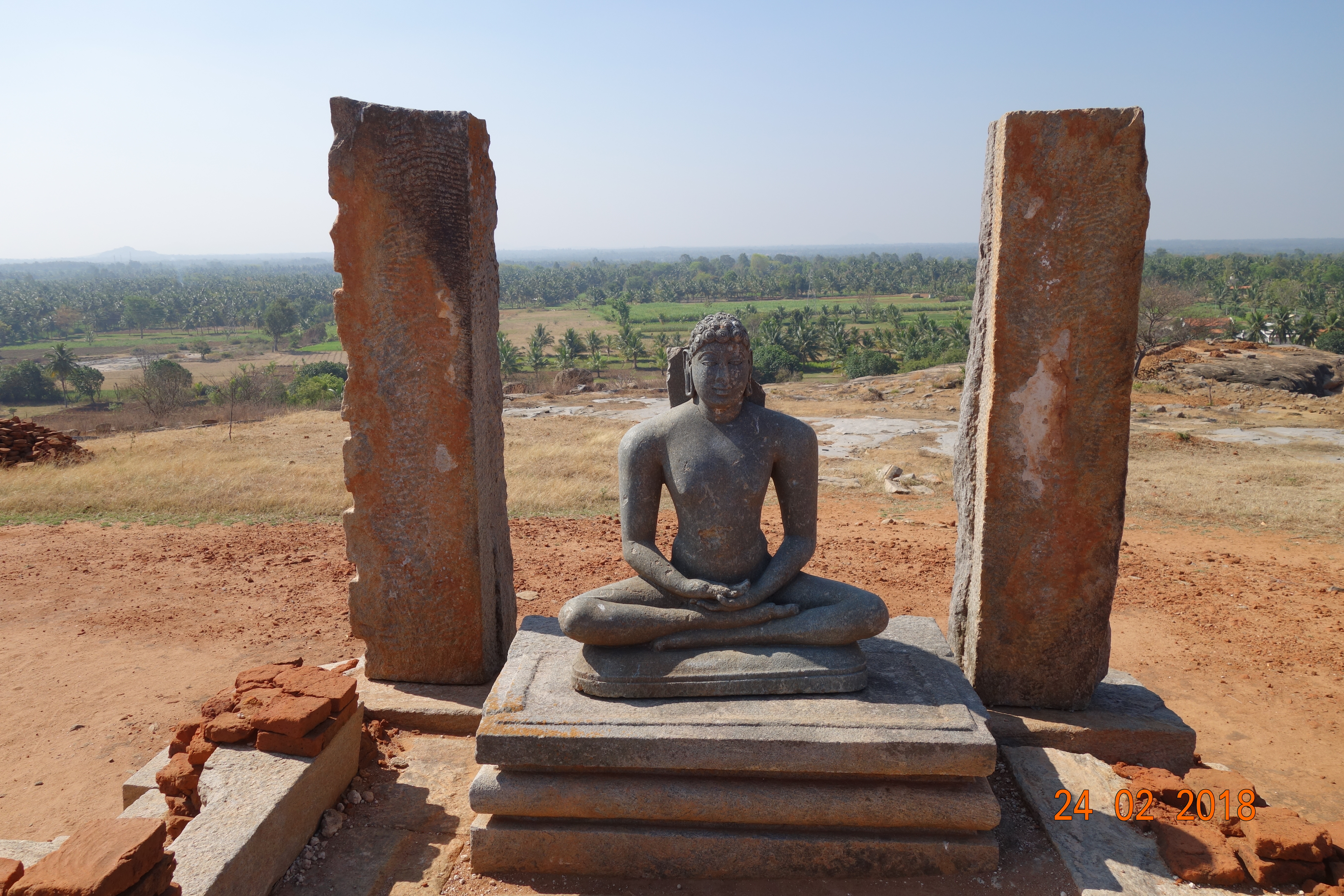
Here, there are footprints of deceased Jain monks carved into stone and samadhi mandapams. Various kinds of ancient ruins can be seen. There is a temple from the Kalabhra period. It is a small, low structure with circularly turned pillars and a heavy stone roof set close to the ground. Inside the sanctum stands Vijaya Parshvanatha. The temple was reconstructed in the 12th century and again in the 16th century. Construction work has begun once more in recent times. Small shrines are being built for the statues of Jain monks that were once placed on the hill. In the 12th century, a small fort wall was built around the temple.
None of us expected such a large site on a barren hill in such a desolate village environment. Tamil historians have never taken note of this temple or this town, even though it is deeply intertwined with Tamil history.
Kanakagiri has been a Jain site since the 1st century BC. It is said that references to this site exist in ancient Jain texts such as Hemanga Desha. Detailed research needs to be carried out comparing such texts with the so-called “Dark Age” of Tamil Nadu – the Kalabhra period. It is believed that the 23rd Tirthankara, Parshvanatha, visited this place and that his Samavasarana (divine preaching hall) was held here. Kanakagiri is South India’s only Sidheswara (a place where Tirthankaras attained liberation).
There are Jain beds and footprints here. This place is linked to the life of the Jain monk Pujyapadacharya, who lived in the 4th or 5th century AD and is believed to have attained samadhi here. Pujyapadacharya was a great physician. He wrote commentaries on ancient Jain texts such as the Tattvartha Sutra and Sarvarthasiddhi, and also authored a grammar text called Jainendra Vyakarana. This remains the foundational grammar text for Jain Sanskrit.
The central temple houses a statue of Parshvanatha in the Kayotsarga posture (standing meditation). Parshvanatha was worshipped as the tutelary deity of the Hoysala kings. Near him stands Padmavati Devi, the Yakshi of Parshvanatha. It is said that this temple was built by the Ganga kings in the 5th century AD. In the last century, a Jain monk named Chandrasagara lived in Kanakagiri and carried out renovation work here.
Outside the temple, a tall statue of Parshvanatha stands in the open air, with a statue of the Yakshi Padmavati below. It is an intricately sculpted figure. Like most Jain temples, this place also has a Jain library and a Tavashala (hermitage) for visiting monks. There is also a Bhojanasala (dining hall) for visiting Jains. We decided to eat the food we had brought right there. After eating, we left for Mysore.
Instead of going directly to Mysore, we took a detour to Gommatagiri, which is located about 25 km away. This was where we first had the darshan of Bahubali Swami. If one climbs the steps carved into the steep monolithic rock, one reaches the small Gommatagiri Bahubali Swami temple at the top. It has been an important Jain place of worship. Originating as a Jain center in the 2nd century AD during the Kalabhra period, Gommatagiri has remained a continuous place of worship to this day.
The Bahubali Swami statue here is about 700 years old. It was created in the 12th century. The hill is called Shravana Gudda. This monolithic statue was installed during the early period of the Vijayanagara empire. Apart from this statue standing tall on a single stone, there are no other major statues here. There is a small mandapam around the statue, and nearby are several small shrines established to worship stones inscribed with the footprints of Jain monks.
The story of Bahubali Swami appears in the traditions of Jain and Buddhist monks. The stories and statues of Bahubali largely belong to the South. They are mostly found in Karnataka and are almost non-existent in North India. Legend has it that Bahubali was the son of the Jain Tirthankara Rishabhanatha. Rishabhanatha was the king of a country called Podanpur. His story appears in the Jain text Adipurana. The 10th-century Kannada poet Adikavi Pampa wrote the story of Gommateshwara in the Champu style (a mix of prose and poetry) in Sanskrit.
One thing becomes clear from this story. Jainism is not a North Indian religion, as we often assume. Many of its Tirthankaras were South Indians. Just as Rishabhanatha is worshipped throughout the Kannada land, Parshvanatha is worshipped throughout Tamil Nadu, and he may have belonged to Tamil Nadu. Vardhamana Mahavira was the one who codified the twenty-three Tirthankaras and established the Jain religion. He was a North Indian. His work seems to have organized a tradition of great wisdom that already existed across India. The Jain Tirthankaras are also the Tirthankaras of the Ajivika religion. Ajivika is older than Jainism and was strong in Tamil Nadu even before Jainism arrived. Kaniyan Pungundranar’s verse Yaadhum Oore Yaavarum Kelir (Everywhere is our place, everyone is our kin) fully expresses Ajivika concepts. In this sense, Jainism is not a religion that came to Tamil Nadu. Tamil Nadu played a major role in the creation of Jainism.
Rishabhanatha divided the country among his sons, went to the forest to perform penance, and became a Tirthankara. Bahubali’s elder brother was Bharata. From a young age, Bahubali possessed beauty and intelligence and was loved by the people. This led his elder brother to become jealous. Although the father had divided the country between them, Bharata sought to take over Bahubali’s share and gathered an army. To prevent bloodshed, it was decided that the brothers would engage in a duel. They competed in Drishti Yuddha (staring contest), Jala Yuddha (water fight), and Malyuddha (wrestling). Bahubali means “one with strong arms.”
Bahubali easily defeated Bharata. At the end of the contest, he was about to strike and kill his brother. Instead, he plucked out his own hair, threw it away, and left as a Jain ascetic. Seeking wisdom, he approached the Jain Tirthankara Rishabhanatha and became his disciple. He gave the kingdom to his brother. Bharata underwent a change of heart. After ruling for some time, he too renounced the world and became a disciple of Rishabhanatha. Learning meditation from him, he attained Kevala Jnana (Omniscience). It is said that Bahubali attained liberation while performing penance standing upright, as vines grew over his body and anthills formed around his feet.
There is another story about Bahubali. Despite performing penance for a long time, he did not attain liberation. His sisters, Brahmi and Sundari, asked Adinatha (Rishabhanatha) about this. Adinatha replied that Bahubali would not attain liberation as long as he did not get off the elephant. When his sister went to Bahubali, she saw him standing on an elephant and asked, “Brother, are you performing penance standing on an elephant?” Only then did Bahubali realize that his final obstacle was ego – the thought “I am performing severe penance.” He was standing on that. Once he shed it, he attained enlightenment.
This hill is called Gommatagiri because Gommateshwara resides here. The Gommateshwara statue here is 20 feet tall. As at Shravanabelagola, a Mahamastakabhisheka (Grand Consecration) is performed here once every twelve years. Gommatagiri also has a Bhojanasala and a Dharmashala. The Deccan Plateau stretches wide in all directions. It is a land of short trees and open fields.
From Gommatagiri, we went to Shravanabelagola. We lost our way slightly and reached forty minutes late, at 5:00 PM. We obtained accommodation for all eight of us at the Dharmashala for four hundred rupees. I bathed quickly, and we walked fast to have the darshan of Gommateshwara before it grew dark.
The hill on which Gommateshwara stands, Vindhyagiri or Indragiri, is the taller of the twin hills here. It has more than five hundred steps carved into a massive monolithic rock. The temple of Gommateshwara and the colossal statue are located at the summit. The town’s name, meaning “The White Pond of the Shravanas (Monks),” appears in some inscriptions in Sanskrit as Dhavalasarovaram.
I first came to this town alone in 1983. I returned again in 1986. In 2006, Vasanthakumar, Yuvan Chandrasekar, and I came again in Shanmugam’s car. The Mahamastakabhisheka was taking place then. After witnessing it, we toured the Jain centers of South Canara by car. The sight I saw that day – vermilion, turmeric powder, sandalwood, sacred ash, and milk being poured over the Mahamastakam (great head) of the statue, causing its colors to change continuously – has returned to me again and again in dreams.
This statue of Bahubali Swami stands 17 meters (57 feet) tall. It was installed in 988 AD by Chavundaraya, a minister of the Ganga king Rachamalla Satyavakya. It is said to be the tallest monolithic statue in the world.
We sat before Gommateshwara until darkness fell. Lights began to twinkle across the vast land below. This is a quiet town. There is no noise in the name of worship. There were no vendors calling out. The temple closes at 6:30 PM. We remained until the priest asked us to leave. Afterward, we sat on the steps and talked quietly. We climbed down at 7:30 PM and returned to our rooms.
 Transverse